


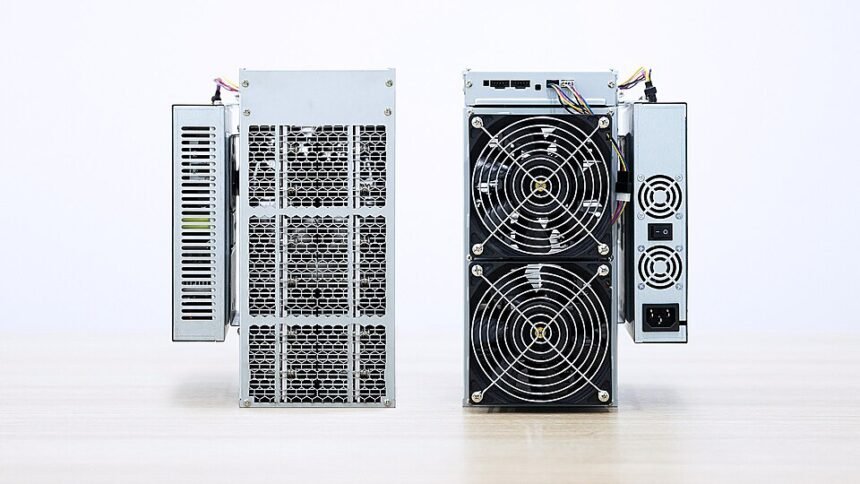
Bitcoin is now trading below what it costs major miners to produce a coin. The price fell to $61,568, under the $62,862 average production cost estimated by CryptoQuant from MARA Holdings filings for the third quarter of 2026, according to BeInCrypto.
Summary
- Bitcoin trades at about $61,500, below the $62,862 average cost of mining one coin for major miners.
- The $62,862 figure comes from CryptoQuant data based on MARA Holdings filings for Q3 2026.
- Network hashrate remains near its record high at about 1.02 zettahashes per second.
- CryptoQuant’s Julio Moreno says Bitcoin has returned to a bearish phase on “basically all metrics.”
- The next levels in focus are $60,000 below and $65,000 above.
The short answer is that Bitcoin now costs miners more to produce than the market pays for it — at least for the large operators the estimate tracks. At roughly $61,500, the price sits about $1,360 below the $62,862 production-cost line, and it has stayed there after first touching the level on November 18.
Mining cost floor faces its third test of 2026
CryptoQuant chief executive Ki Young Ju flagged the move on November 18, warning that a break below the cost level “could pressure public miners and their institutional backers.” He added that hashrate remaining high despite the squeeze suggests public miners “are still betting on a long-term bull market.”
This is the third time Bitcoin has tested the production-cost line this year. In February, the price dropped to the cost level near $64,000. In June and July, it briefly slipped below the roughly $60,000 quarterly cost before recovering.
The figure carries a caveat. It is built from the filings of one company, MARA Holdings, the largest listed miner. Smaller operators likely face higher costs and thinner margins. JPMorgan’s production-cost estimate stood at $85,000 in late September, well above the current price.
Hashrate stays near its record as miners keep investing
Despite the squeeze, the network shows no sign of miner capitulation. Glassnode data puts the 30-day average hashrate near 1.02 zettahashes per second, less than 10% below the record of about 1.1 zettahashes per second set in November 2025.
Hashrate and price have moved in opposite directions since early October. Over that period, hashrate has climbed more than 10% from about 915 exahashes per second, while Bitcoin has lost more than 25%.
In past downturns, falling hashrate signalled operators switching off unprofitable machines. That has not happened this time, even as some miners shift power to artificial intelligence. Hashrate tends to lag price, however — mining hardware is ordered months in advance, and part of the recent growth may reflect machines bought when Bitcoin traded near $87,000.

On-chain indicators turn bearish, analyst warns
Julio Moreno, head of research at CryptoQuant, said the market has turned. “There’s no sugarcoating it, by basically all metrics, Bitcoin returned to a bearish phase,” he said, adding that both spot and speculative demand have contracted sharply since late October and that the analysts CryptoQuant tracks are the most bearish since November 2025.
His chart of long-term holder spending by price level shows where the remaining support sits. The densest cluster of 2026 lies between $62,500 and $65,000, where 30-day long-term holder spending reached 250,000 to 475,000 BTC on many days. Below $62,000, that activity thins out sharply. Moreno acknowledged some capitulation, with holders realising large daily losses, but warned there is still room for more selling.
Bitcoin mining cost and the $62,000 floor
Three separate signals now converge near the same price: the mining cost at $62,862, the recent low near $61,000, and the densest long-term holder cluster beginning at $62,500. A sustained break below $62,000 would remove both the miner floor and the strongest remaining on-chain support. In that case, $60,000 becomes the next level to watch, followed by the 2026 low near $57,700.
On the upside, Bitcoin would need to reclaim $65,000 to clear the long-term holder cluster. The next heavy zone, between $76,000 and $82,000, could then act as resistance.
Macro pressure adds to the strain. US spot Bitcoin exchange-traded funds have recorded about $2.6 billion in net outflows in November, and minutes from the Federal Reserve’s latest meeting have revived talk of a December rate hike.
Moreno still sees Bitcoin in a value zone, yet he cautions that a recovery could take time. “Historically, a bottoming process and subsequent recovery has taken months, even if there are short-term rallies in the process,” he said.
Bitcoin fell below $62,000 earlier this week to its lowest since July, and the slide has continued since. At about 05:03 UTC on November 20, Bitcoin traded at $61,503, down 3.1% over 24 hours, with Ether at $1,726.91 and the Crypto Fear & Greed Index at 12, in Extreme Fear. Readers weighing whether mining still pays at these prices can check the figures with the site’s crypto mining calculator.
Update — November 20, 2026 (evening): JPMorgan analysts led by Nikolaos Panigirtzoglou say Bitcoin’s slide has widened the gap to their estimated $86,000 production cost. Bitcoin traded near $65,000 when the report was published on Wednesday, about $21,000 below the estimate, and Friday’s drop below $60,000 widened the gap to more than $26,000. Higher-cost miners likely sold reserves to raise cash, keep operating or fund a move into artificial intelligence, the analysts said, adding that the gap could narrow as hashrate declines and mining difficulty adjusts when unprofitable miners exit the network. The analysts also said crypto ETF outflows were heavier in the latest two weeks than in the previous four, driven largely by retail investors, while positioning in CME futures largely held up. Source: The Block