


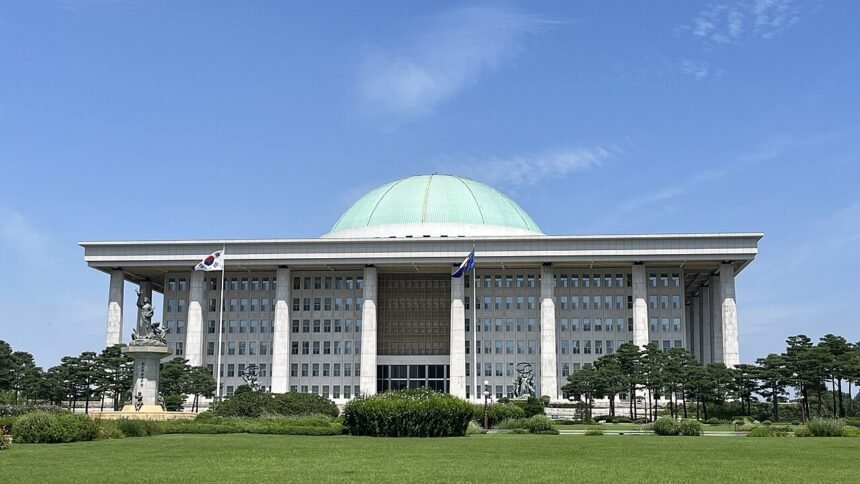
South Korea’s Financial Services Commission unveiled its government proposal for the Digital Asset Basic Act on Tuesday, November 24, setting a 20% cap on major shareholders of crypto exchanges, a bank-led model for won-backed stablecoins, and a licensing regime for crypto businesses, Maeil Business Newspaper reported.
South Korea’s government has unveiled its draft Digital Asset Basic Act: exchanges face a 20% major-shareholder cap, won stablecoins will be issued by bank-majority consortia, domestic token sales return under disclosure rules, and crypto businesses move from a registration system to licensing — but the proposal is not law yet and still needs National Assembly review and a vote.
Summary
- The FSC unveiled the proposal on November 24 at its 6th Virtual Asset Committee meeting, chaired by Lee Eok-won, about a year and ten months after phase-two legislation discussions began.
- Major shareholders of exchanges will be capped at 20% in principle, with financial companies able to hold up to 34% with FSC approval; voting rights on shares above the limit will be restricted, and exchanges get a three-year grace period, with small and medium-sized exchanges eligible for three more years.
- Won-backed stablecoins will be issued by consortia in which banks hold a combined majority stake, though fintech and technology firms may be the single largest shareholder; issuers need equity capital of more than 5 billion won (about $3.6 million) and FSC approval, must hold reserves above 100% of the issued balance, and must guarantee holders’ right to redeem at face value.
- Domestic initial coin offerings will be allowed on the condition of sufficient information disclosure, and crypto businesses will be split into trading, brokerage, storage and operation, with licensing for the first three and registration for operation businesses.
- Operators will face no-fault liability for losses from hacking or computer failure, and punitive fines of up to 10% of sales for breaching computer-safety obligations.
- The bill is expected to be introduced through Yoo Dong-soo, chairman of the National Assembly’s Political Affairs Committee, and must pass parliamentary review before it can take effect.
FSC: “We can no longer delay”
The proposal moves South Korea beyond a framework built for user protection and unfair-trading prevention toward one that also covers industry development and market order, according to the FSC’s presentation at the committee meeting. FSC Chairman Lee Eok-won said the government “can no longer delay the establishment of a systematic discipline system for digital assets” and pledged to “actively try to legislate as soon as possible after sufficient discussion at the National Assembly.”
South Korea currently regulates crypto under two laws: the Specific Financial Information Act, which covers registration and anti-money-laundering duties, and the Virtual Asset User Protection Act, which governs customer assets and unfair trading, crypto.news reported. The new act would replace parts of that patchwork with activity-based licensing, with capital, staffing, cybersecurity and internal-control requirements varying by the risks of each business.
Exchange ownership cap targets Upbit and Bithumb
The ownership cap was the most contested item in the proposal. Applying a distribution-of-ownership standard equivalent to the alternative exchange system in capital markets, the government set the major-shareholder limit at 20% in principle, with financial companies and others able to hold up to 34% if the FSC approves. Shares above the limit lose their voting rights rather than forcing a sale, and existing and new exchanges receive a three-year grace period after designation, with smaller exchanges able to claim an additional three years.
Any final restriction would fall hardest on the country’s largest platforms, including Upbit and Bithumb, and could affect the planned share exchange involving Upbit operator Dunamu and Naver Financial. Listing and delisting standards, which currently rest partly on exchange rules and industry guidance, may become legally binding under the proposed act.

Banks take the majority stake in won stablecoins
Stablecoin issuance was the second major dispute. The Bank of Korea favours a consortium model in which banks collectively control at least 50% plus one share of an issuer, and the government’s proposal adopts that structure — while opening the way for fintech and technology companies to take part as the single largest shareholder. Issuers must hold equity capital above 5 billion won and obtain FSC approval, with detailed shareholder-composition rules to be set in the enforcement decree.
Reserve and redemption rules are strict: issuers must secure more than 100% of the issued balance as reserve assets, and holders’ right to claim repayment at face value is guaranteed. The model drew objections from fintech businesses that want qualified non-bank companies to issue won-linked tokens, and rules covering payments, distribution and settlement are expected to feature in the draft. Some financial firms have already started testing services without waiting for the law — Kakao Pay and KakaoBank signed an agreement with Fireblocks in September to examine stablecoin infrastructure, without announcing a token launch.
Stablecoin reserves and redemption have become a live issue in Korea’s market beyond the legislation: Sky Protocol’s USDS stablecoin has shrunk as exits drained $1.5 billion from its reserves, and the FSC’s proposal would put bank-issued won stablecoins under a far stricter reserve regime than the one that governs most crypto-native stablecoins today.
ICOs return, and operators face tougher liability
The proposal also reopens domestic issuance and sale of digital assets — initial coin offerings — on the premise of sufficient information disclosure, ending a de facto ban that has pushed Korean projects to issue tokens overseas. The digital asset business will be subdivided into trading, brokerage, storage and operation, with a licensing system for trading, brokerage and storage and a registration system for operation businesses, a structure designed to draw more operators into the market.
User protection is tightened alongside the opening. In the event of hacking or computer failure, operators will be liable for damages without fault, and violations of computer-safety obligations can draw punitive fines of up to 10% of sales. The FSC had already signalled the direction at a November 12 security meeting, saying forthcoming legislation would require digital asset businesses to meet IT safety and compensation obligations comparable to those imposed on financial companies.
What happens next
Based on the government’s proposal, the legislation will be carried forward by Yoo Dong-soo, chairman of the National Assembly’s Political Affairs Committee, who is expected to formally introduce the bill. The committee would examine it together with existing digital asset bills from ruling and opposition lawmakers before any legislation could advance through further review and a parliamentary vote — so the ownership cap, the stablecoin model and the licensing terms can still change.
Separately, South Korea’s finance ministry said on November 5 that it would seek to postpone the planned tax on cryptocurrency gains from 2027 to 2029, a change that would also need legislation and is not part of the Digital Asset Basic Act. The FSC’s move comes a day after it tightened crypto anti-money-laundering rules, scrapping the 1 million won threshold for Travel Rule checks on transfers — a separate measure announced on November 23.
Bitcoin traded at $60,418 at about 06:08 UTC on Tuesday, down 2.01% in 24 hours, after dipping to about $59,404 in Asian trading — below $60,000 intraday, though the daily close will decide whether the level has actually broken. Ether traded at $1,698.99. Bitcoin has fallen about 20% in November and notched a seventh straight weekly decline, its second-longest weekly losing streak on record, with US spot Bitcoin ETFs shedding about $1.8 billion last week.