


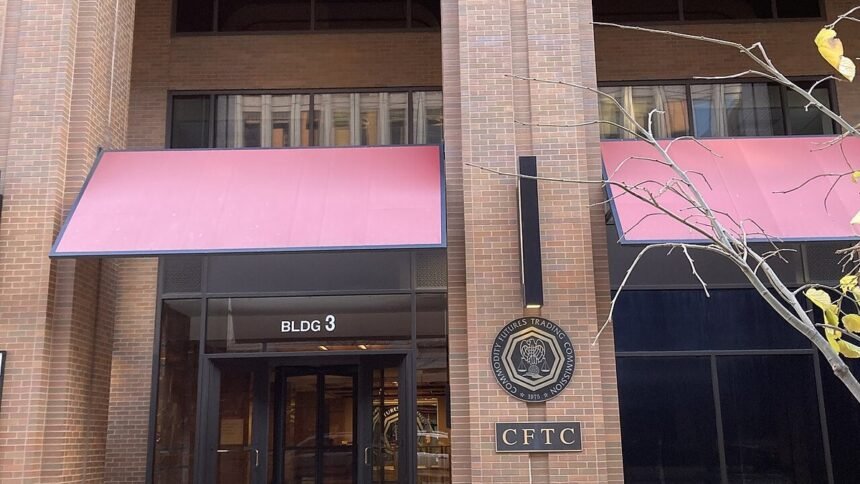
US derivatives exchanges and clearinghouses can now count Bitcoin and Ether toward the financial cushion they are required to hold, after Commodity Futures Trading Commission staff said on November 23, 2026 that the crypto assets qualify as financial resources — with a discount.

Summary
- CFTC staff issued Staff Letter No. 26-31 on November 23, 2026, jointly from the Division of Market Oversight and the Division of Clearing and Risk.
- Designated contract markets, swap execution facilities and derivatives clearing organizations may count Bitcoin, Ether and qualifying payment stablecoins toward the financial resources covering at least 12 months of operating expenses.
- Bitcoin and Ether carry a minimum 20% haircut, so $100 of Bitcoin counts as $80 toward the requirement. Payment stablecoins carry a 2% haircut, so $100 counts as $98.
- Other crypto assets generally receive a 100% haircut and count as zero.
- The separate liquidity requirement is unchanged: crypto cannot satisfy it, because it is not cash or a highly liquid security under US accounting rules.
Yes — regulated US derivatives venues can now use Bitcoin and Ether to help meet their operating-reserve requirement, but only at 80 cents on the dollar, and only for the 12-month financial-resources cushion, not for the separate short-term liquidity test. The guidance, reported by Cointelegraph, is staff advice rather than a new rule, and it does not change any firm’s obligation to hold cash for its liquidity requirement.
What the CFTC’s new crypto guidance allows
The advisory answers a narrow question that the rules had left unclear: whether a regulated derivatives venue could point to its crypto holdings when proving it has enough money to keep operating for a year. CFTC rules require designated contract markets, swap execution facilities and derivatives clearing organizations to maintain financial resources sufficient to cover at least 12 months of operating costs on a rolling basis. Until now, the rules did not explicitly say crypto could count toward that cushion.
Under Staff Letter No. 26-31, some crypto can count, with a valuation discount — a haircut — applied to reflect the risk of holding it. Staff said they would not object to a minimum 20% haircut for Bitcoin and Ether and a 2% haircut for qualifying payment stablecoins. Assets that are not readily marketable, and tokens that do not qualify as payment stablecoins, would generally receive a 100% haircut, meaning they count for nothing.
The catch: the liquidity rule still applies
Crypto still cannot meet the separate liquidity requirement that sits on top of the 12-month cushion. Swap execution facilities must hold cash or highly liquid securities equal to three months of operating costs, and designated contract markets and derivatives clearing organizations must hold six months’ worth. The CFTC said virtual assets, including payment stablecoins, do not qualify as cash under Generally Accepted Accounting Principles or as highly liquid securities under the relevant rules, so they cannot be used for that test.
The distinction matters because the two requirements serve different purposes. The 12-month financial-resources cushion covers operating costs and certain business losses. The liquidity floor is the money a venue must be able to reach immediately. A venue holding Bitcoin can now count part of it toward the first, but must still hold cash or liquid securities for the second.
“Important clarity on crypto assets in US derivatives markets”
CFTC Chairman Michael Selig welcomed the advisory in a post on X, writing: “Pleased to see @CFTC staff continue to provide important clarity around crypto assets in US derivatives markets through today’s staff advisory.”
The guidance is limited in scope. It reflects the views of staff in the two divisions, not a formal rule change approved by the Commission, and it creates no enforceable rights. It is not a no-action letter, and it does not address the use of crypto to meet a clearinghouse’s default-resource requirements. Registered entities must also account for wrong-way risk — the possibility that falling crypto prices could coincide with losses in their own businesses.
Who it covers, and what came before
The advisory applies to the venues where America’s regulated crypto derivatives trading happens. According to Cointelegraph, CFTC-regulated entities include Coinbase Derivatives, Crypto.com’s North American Derivatives Exchange and Bitnomial Exchange, as well as prediction markets Kalshi and Polymarket US.
The move is the latest step in a sequence rather than a one-off. The CFTC first allowed Bitcoin, Ether and USDC to serve as collateral for derivatives transactions in December 2025, and three months later its staff introduced capital charges of 20% for Bitcoin and Ether and 2% for payment stablecoins held by brokers, in line with Securities and Exchange Commission guidance. Letter 26-31 extends that same framework from broker capital and collateral into the operating-cost reserves that registrants must maintain. The 20% haircut is not new math — the CFTC established it earlier this year in a March 2026 FAQ and applied it to futures commission merchant proprietary Bitcoin positions. What is new is the broader set of entity types it now covers.
The advisory also lands alongside other CFTC action on Monday: the agency published a final rule creating a reporting framework for certain event contracts. Selig said in a statement that the CFTC “will no longer regulate market participants through a patchwork of no-action letters, which serve as band-aids for unworkable regulations.”
Market context
The guidance arrives in a weak market. Bitcoin traded at $60,662 at 05:43 UTC on November 24, down 1.46% over 24 hours, still above $60,000 intraday but below the $63,500 level it briefly reclaimed on November 23 before closing the day at about $61,228. Ether traded at $1,706.28. The Fear and Greed Index stood at 11, classified as Extreme Fear. US spot Bitcoin ETFs have recorded heavy recent withdrawals, with about $1.8 billion drained last week — the most since June — and November outflows now at $4.14 billion, according to SoSoValue. The CFTC’s move does not change those flows, but it gives regulated venues one more way to hold crypto inside the US regulatory perimeter — at a discount the agency has now written down twice.
For US regulators, the pattern is consistent: the Department of Justice is separately pursuing the recovery of crypto stolen in the $6.3 billion Binance hack, having filed to forfeit more than $1.1 billion in USDC on November 23. Enforcement and market-structure clarity are advancing in parallel — one seizing stolen crypto, the other defining how lawfully held crypto counts on a regulated venue’s books.
Bitcoin’s price remains the near-term question. It is holding above $60,000 intraday, but the daily close will decide whether the level holds. The next macro test is Wednesday’s US PCE inflation report. For now, the CFTC’s letter changes the accounting, not the market — Bitcoin is still trading in the low $60,000s, and the guidance produced no major market reaction.
Sources: Cointelegraph, The Block, TFTC. Market data: CoinGecko, 05:43 UTC November 24, 2026. Fear and Greed Index: alternative.me.