


Two of the most senior crypto lawmakers in Washington said on Thursday that Congress missed its chance to pass the Clarity Act, the bill that would set the rules for US crypto markets — and that the chances of reviving it before this Congress ends are effectively zero, The Block reported.
The Clarity Act will not pass during the lame-duck session: Sen. Bernie Moreno put the chances at “zero,” and Rep. French Hill, who chairs the House Financial Services Committee, said the chances are “not high.”
Summary
- Rep. French Hill and Sen. Bernie Moreno, speaking separately on Thursday at the Capitol Crypto Forum, said advancing the GENIUS stablecoin law without the Clarity Act was a mistake.
- The Clarity Act passed the House in July 2025 but failed a Senate cloture vote 49–50 on September 15, 2026, short of the 60 votes needed to advance.
- Moreno said the SEC and CFTC could deliver 80% of a crypto framework through rulemaking; Hill said rulemaking “does not have the force of law” and is “not a permanent fix.”
- The bill grew from 300 pages to 600 pages during negotiations; Moreno said “time kills all deals.”
- Both lawmakers left the door open to restarting bipartisan talks with the House-passed bill — in the next Congress.
“Time kills all deals”
Both lawmakers said it was a mistake to advance the GENIUS Act separately from Clarity, which passed the House but stalled after a failed Senate vote in September. Hill said he had urged the Senate and the administration last summer to pass the two bills together.
“I urged the Senate and the administration last summer to have Clarity and GENIUS passed together in the House,” Hill said. “And I still stand by that.”
Moreno, a former car dealer, gave a sales analogy for the breakdown. “Time kills all deals,” he said, adding that lawmakers failed to capitalize on momentum from the stablecoin legislation. “The bill started at 300 pages, ended up at 600 pages,” Moreno said.
The GENIUS Act, the stablecoin law, was signed on July 18, 2025 and takes effect on January 18, 2027, with the OCC finalizing its implementing rules on October 21, 2026, according to KuCoin. Hill argued that Congress still needs to finish the job: “To have GENIUS but not market structure is a huge mistake.”

The September vote that stopped it
The Clarity Act, formally the Digital Asset Market Clarity Act (H.R. 3633), was introduced by Hill on May 29, 2025. The House approved it on July 17, 2025, by a vote of 294–134. The Senate proved less welcoming: on September 15, 2026, a cloture vote on the bill failed 49–50, short of the 60 votes needed to take it up.
The main obstacles were disputes over ethics provisions covering federal officials’ crypto holdings and over stablecoin yield. Former White House crypto adviser Patrick Witt, whose remarks were made public earlier this week, called the Senate’s failure a “failure of American leadership.” The bill is not formally dead: Sen. Thom Tillis voted no so that he could enter a motion to reconsider, which preserves a path to revive it — though passage during this Congress is now widely viewed as unlikely.
“80% through rulemaking” — Moreno’s plan, Hill’s warning
With legislation stalled, the two lawmakers offered different assessments of how much regulators can accomplish on their own. Moreno said agencies could deliver much of the framework themselves.
“I’m a little bit more bullish than French,” Moreno said. “I think it can accomplish 80% through a very rigorous rulemaking process that can’t be unwound.”
Moreno added that the Securities and Exchange Commission and the Commodity Futures Trading Commission should use the next two years to establish rules that would make it difficult for a future administration to undo. “Is that the right way to do it? No,” he added. “I think the right way to do it is Congress should pass the Clarity Act.”
Hill argued that agency action cannot provide the permanent legal certainty that legislation would. He said that since the Clarity Act’s failure, regulators have mostly followed in the footsteps and goals of market structure proposals — but their authority is limited.
“My argument is it’s not a permanent fix. It is subject to litigation. It does not have the force of law,” Hill said.
“Zero. Zero.” — the lame-duck verdict
Neither lawmaker had much hope for passage during the lame-duck session. Asked what was realistically possible to achieve over the coming weeks, Moreno answered: “Zero. Zero.”
Hill was slightly more optimistic, saying lawmakers “never give up hope in a lame duck,” though “the chances are not high.”
A possible reset
Hill said it was a good sign that Rep. Maxine Waters pointed out digital asset market structure as an issue she intended to address if she is elected as committee chair.
Moreno also said bipartisan negotiations were not off the table, while blaming earlier talks for being “tornadoed” in disputes over President Donald Trump and ethics. He said he would consider restarting negotiations with the House-passed legislation.
“By the time we got to September with the Senate version, it was just very, very, very complicated,” Moreno said.
What it means while Washington waits
While US lawmakers debate, the market backdrop stays weak. Bitcoin traded at $63,091 at 16:26 UTC on Thursday, according to CoinGecko, with Ether at $1,777.61 and the Fear & Greed Index at 10, in extreme fear. Onchain analytics firm CryptoQuant says Bitcoin is back in a bearish phase, with demand shrinking at its fastest pace since July — read the full breakdown here.
Regulators elsewhere are moving faster than Washington. Russia’s central bank plans to let ordinary investors trade bitcoin on margin, capped at 300,000 rubles, with the rules expected to be registered by the end of 2026 — read the full story here. For US crypto firms, the wait for a market structure law now stretches into the next Congress.
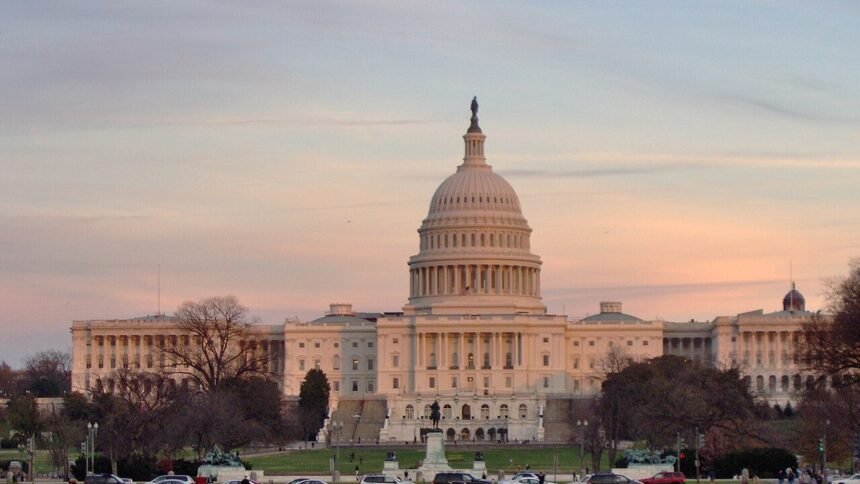
Featured image: The United States Capitol at dusk (Wikimedia Commons, CC BY-SA 3.0).